
For years, the promise of cryptocurrency payments in e-commerce felt like a niche experiment. Fast-forward to 2026, and the landscape has fundamentally shifted. As global e-commerce continues its exponential growth, merchants are seeking two critical things: lower transaction fees and access to the burgeoning, borderless market of digital asset holders.
The good news? The technology is ready. The bad news? Many existing solutions are clunky, confusing, and fail the ultimate test of user experience (UX), which is why we’re here.
A “frictionless” crypto payment system is one where the customer experience is as smooth, or smoother, than using a credit card. For any merchant serious about capturing market share and integrating Web3 payments for merchants, eliminating this friction is the single most important step.
Global Trends in eCommerce + Web3 Payments
The rise of stablecoins (digital currencies pegged to fiat, like USD) has been the game-changer for digital commerce. In 2026, stablecoins are the preferred medium for day-to-day transactions due to their speed and lack of volatility.
- The Global Customer: Cryptocurrencies offer a native way to transact across borders without painful currency conversions and high international interchange fees. Merchants who accept crypto payments e-commerce gain immediate access to an untapped global customer base.
- Cost Efficiency: Traditional payment rails can charge 2-4% per transaction. Modern crypto payment processors can significantly cut these costs, providing a crucial margin advantage.
Understanding Payment Flows: The Friction Point
To achieve true frictionlessness, merchants must choose the right payment flow. The key distinction is between legacy systems and modern, hybrid rails.
1. Wallet-to-Checkout vs. Card + Crypto Rails
- The Legacy Flow (Wallet-to-Checkout):
- This involves the customer transferring crypto from their personal wallet directly to the merchant’s wallet.
- The Friction: Slow confirmation times, volatile currency fluctuations during the process, high gas fees (depending on the chain), and the need for the merchant to manually manage wallets and conversions. This is the definition of a high-friction experience.
- The Frictionless Flow (Hybrid Rails):
- This is the modern standard. It uses payment processors that integrate deeply with both crypto networks and traditional finance.
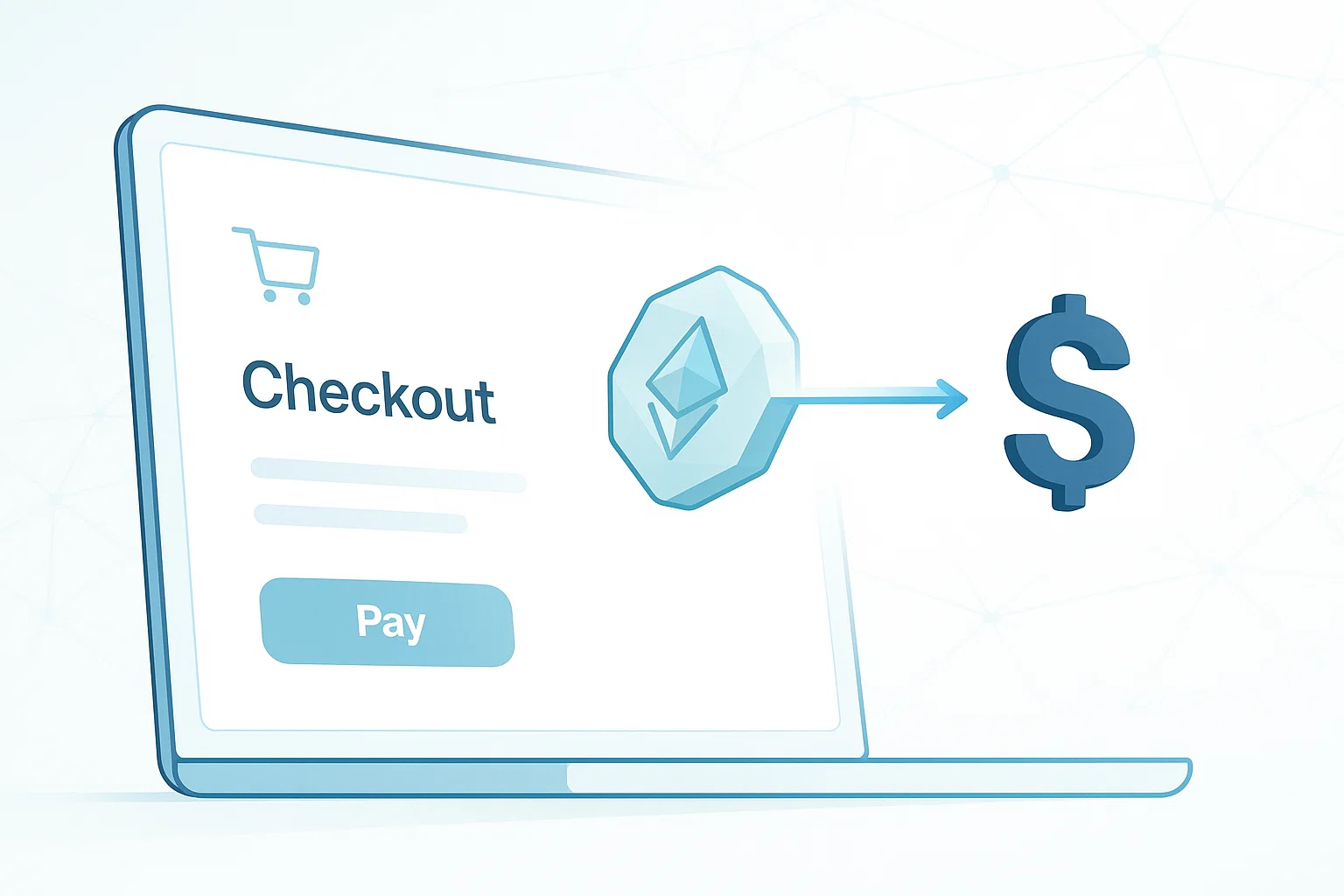
- The Benefit: The customer pays with crypto (e.g., a stablecoin), but the payment provider instantly converts the assets and settles funds to the merchant in their local fiat currency (USD, EUR, etc.)—or a stablecoin—all within seconds. The merchant receives guaranteed, non-reversible funds without ever touching the complexity of volatile assets or on-chain risk.
2. On-Ramps & Off-Ramps: A Merchant’s Perspective
A reliable third-party provider will handle the complex processes known as on-ramping and off-ramping:
- On-Ramps: Converting fiat currency (e.g., your customer’s bank account) into crypto.
- Off-Ramps: Converting crypto (e.g., the payment you received) back into fiat.
How to Convert Fiat ↔ Stablecoins Safely:
As a merchant, your focus should be on choosing a compliant, licensed payment processor that assumes all regulatory and technical risk for handling these conversions. Look for partners that offer instant settlement, ensuring you are protected from volatility and regulatory headaches. The safest way to handle this is to have the processor deal with the volatility and compliance, ensuring you get your local currency immediately.
Integration Options: The Practical Guide
Integrating crypto payments should take minutes, not days. The best option for you depends on the size and complexity of your existing e-commerce setup.
1. Plugins (Shopify, WooCommerce, etc.)
For 90% of e-commerce stores, a simple plugin is the answer to how to accept crypto payments.
- Actionable Step: Research payment processors that offer one-click integration plugins for your platform (e.g., Shopify, WooCommerce, Magento). These plugins add a “Pay with Crypto” option at checkout and manage the entire transaction lifecycle—from pricing conversion to settlement.
2. Custom API Integration
For large enterprises, custom platforms, or businesses needing granular control over the payment flow and data, a custom API is the best choice.
- Actionable Step: Use the payment processor’s SDK (Software Development Kit) and REST API. This allows you to integrate the crypto payment functionality directly into your backend, customize the checkout experience, and define exactly which cryptocurrencies or stablecoins you accept.
UX Best Practices: Reducing Friction at Checkout
The biggest difference between a failed crypto payment implementation and a successful one is user experience.
| Friction Point | UX Best Practice for 2026 |
|---|---|
| Confusing Pricing | Always display the price in the customer’s local fiat currency (e.g., $99.99 USD) and show the equivalent crypto price after they select the crypto option. |
| Manual Wallet Entry | Implement Wallet Auto-Detection at checkout. The system should automatically recognize major browser-based wallets (like MetaMask or various mobile wallets) and allow a one-click connection and signature. |
| Waiting for Confirmation | Use instant payment protocols (often layer-2 solutions) that allow the merchant to ship the product immediately after the transaction is broadcast, relying on the processor to guarantee settlement. |
| Wallet Onboarding Tips | Provide a concise, clear modal if the customer doesn’t have a wallet, explaining in two simple steps how to set one up or link an existing one. Never force them to use a specific, obscure wallet. |
Real-World Examples: How Crypto Boosted Conversion
In the modern crypto payments e-commerce landscape, success stories often revolve around stablecoin adoption for international sales:
Case Study: The Global Digital Goods Merchant
- A software company saw 70% cart abandonment on sales to Latin America and Southeast Asia due to high credit card decline rates and international banking fees.
- Solution: They implemented a seamless payment rail accepting only USD stablecoins (like USDC or USDT).
- Result: They saw a 15% increase in conversion rates in target regions. Fees were cut by over 50%, and chargebacks became virtually non-existent, as blockchain transactions are non-reversible.
Case Study: The Boutique Fashion Retailer
- A high-end retailer began accepting crypto payments but was settling to fiat.
- Solution: They switched to a processor that allowed stablecoin settlement directly to their treasury.
- Result: This dramatically lowered their global transaction processing costs and gave them instant liquidity, enabling faster payment to international suppliers who also accept stablecoins.
Summary & Next Steps
The era of clunky, intimidating crypto payments is over. In 2026, how to accept crypto payments is less about the “crypto” and more about optimizing the “payments” experience. The future of global commerce is borderless, and friction is officially obsolete.
Key Takeaways:
- Prioritize UX: If it’s harder than paying with a card, it will fail. Focus on instant, one-click solutions.
- Use Hybrid Rails: Don’t deal with on-chain complexity; use a processor that guarantees fiat/stablecoin settlement immediately.
- Target Global Growth: Use crypto to sidestep costly international banking fees and capture the unbanked or underbanked global customer.
To begin your integration of Web3 payments for merchants, your next step is to evaluate modern, licensed payment gateway providers who specialize in instant, stablecoin-based e-commerce settlements.